Illinois is one of the growing markets in our database, and the data so far tells an interesting story. With 41 unit analyses spread across 6 cities, it's still early — but there's already enough here to see patterns forming. Unsurprisingly, the data skews heavily toward Chicago, which dominates the state's online auction volume. But a few suburbs are quietly posting some of the stronger scores we've tracked anywhere.
Here's what the numbers actually look like.
Illinois at a Glance
Note: Neighborhood wealth and income data is not yet available for Illinois. Census data is still being processed for this state and will be added as it becomes available.
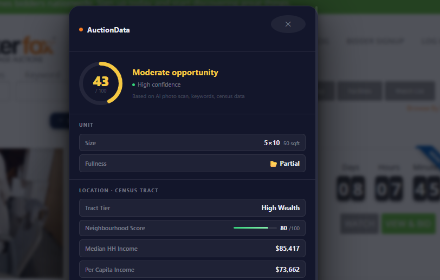
Each listing gets a full scorecard — AI item detection, eBay sold prices, and a max bid calculator.
What the Data Shows
Illinois currently has the second-highest average opportunity score of all states we track, sitting at 49. That's a meaningful number. It tells me that the units hitting online auction platforms in Illinois tend to have decent visible contents, reasonable packing quality, and enough going on in the photos that the AI is finding things worth flagging.
The concentration is heavy in Chicago — 30 out of 41 analyses come from the city itself. That makes sense. Chicago has a massive number of self-storage facilities, and the online auction platforms pull heavily from that metro area. The remaining 11 analyses are scattered across five suburbs, but even with small sample sizes those suburban numbers are worth paying attention to.
Scores by City
| City | Units Analyzed | Avg Score |
|---|---|---|
| Evanston | 2 | 55 |
| Romeoville | 4 | 54 |
| Elgin | 1 | 51 |
| Chicago | 30 | 48 |
| Bellwood | 3 | 46 |
| Kankakee | 1 | 45 |
The table is sorted by average score. Every city except Bellwood and Kankakee is scoring at or above 50 — the midpoint of our scoring range. That's a strong showing overall for the state.
Chicago's Storage Auction Market
Chicago accounts for 30 of the 41 analyses in our Illinois dataset, which makes it by far the most-analyzed city in the state. The average score of 48 sits just below the state average, pulled down slightly by the sheer volume — when you're looking at 30 units, you're going to get a wider spread that includes some lower-quality listings alongside the stronger ones.
What stands out about Chicago is the volume. There are a lot of storage facilities in the metro area, and that means a lot of units hitting the online platforms every week. For buyers, that volume is a double-edged sword. On one hand, you have more opportunities to find strong units. On the other, you're competing with more buyers who are scanning the same listings. The tool helps here — when you're sifting through 15-20 Chicago listings in a session, having a scored breakdown of each one saves real time and keeps you from glazing over the details.
I expect Chicago's sample size to grow fast. As more users run analyses on Illinois listings, the city-level data will get sharper and more reliable.
Suburban Standouts
The most interesting part of the Illinois data isn't Chicago — it's the suburbs. Three cities are outscoring the city proper, and the margins are meaningful.
Evanston leads the state with an average score of 55 across 2 analyses. Evanston sits just north of Chicago on the lakefront, and it's home to Northwestern University. The demographic profile skews higher income, which tends to correlate with better-quality items in storage units. Two analyses isn't a large sample, but 55 is a strong number — well above the state and national averages.
Romeoville comes in at 54 across 4 analyses. That's a slightly more reliable sample, and the consistency is encouraging. Romeoville is a southwest suburb about 30 miles from downtown Chicago, a solidly middle-class area with a lot of residential storage demand. Four units averaging 54 suggests there's decent opportunity in the suburban facilities that don't get as much bidding attention as the Chicago locations.
Elgin rounds out the suburban leaders at 51 with a single analysis. One data point isn't enough to draw conclusions, but it's another suburb posting above the city average. Elgin is about 40 miles northwest of Chicago, and it fits the pattern — suburban facilities where competition may be lighter and unit quality holds up.
The takeaway: don't sleep on the suburbs. Chicago gets the volume and the attention, but the data suggests suburban facilities in the collar counties are producing units that score just as well or better, likely with fewer bidders fighting over them.
Income Data: Coming Soon
One thing you'll notice is that this page doesn't include the neighborhood wealth and income breakdown that we show for some other states. That's because Census Bureau income data hasn't been fully processed for Illinois locations yet. We're working on expanding that coverage, and when it's ready, this page will be updated with median household income data for each city's storage facilities.
Income data matters because it adds a demographic context layer to the scores. A unit scoring 50 in a high-income zip code is a different proposition than a unit scoring 50 in a lower-income area — the expected contents and resale categories shift. Once that data is populated for Illinois, the picture will get a lot more complete.
Get scored analyses on every listing you view — AuctionData runs AI image analysis, neighborhood data, and keyword scoring on units from StorageTreasures, LockerFox & StorageAuctions. Works right in your browser.
How to Use This Data
This page is a snapshot — a look at what our database has collected for Illinois so far. The numbers will shift as more users run analyses and more units get scored. If you want to see the live, up-to-date picture, check the heat map. It shows every scored location in real time as the dataset grows, so you can zoom into specific Illinois cities and facilities to see what's happening right now.
If you're buying storage auctions in Illinois, whether in Chicago or the suburbs, the data suggests this is a market worth watching. The scores are solid, the volume is there, and as the dataset fills out with income data and more analyses, the picture will only get sharper.