North Carolina has quietly become the strongest market in our dataset. Across 66 unit analyses in 15 cities, the state averages an opportunity score of 48 — the highest of any state we currently track. And the bulk of that activity is concentrated in one metro: Charlotte.
This isn't theoretical. Every number on this page comes from real units analyzed through AuctionData on StorageTreasures, LockerFox, and StorageAuctions. Here's what the data looks like.
For context, the average median household income across our NC facilities is $68,944, with an average median home value of $274,442. That's solidly middle-class territory with enough economic diversity to create interesting variation between markets.
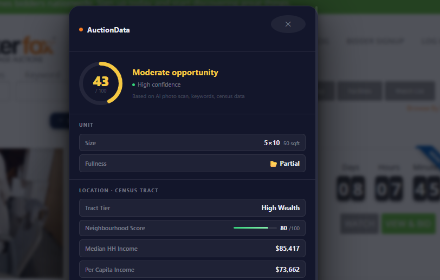
Every listing gets a scorecard with AI item detection, eBay sold prices, and Census neighborhood data.
What the Data Shows
North Carolina's lead over other states isn't driven by one outlier city. It's the consistency across the Charlotte metro that lifts the average. Charlotte proper, Harrisburg, Concord, Huntersville, Denver, and Dallas are all within a 30-mile radius, and together they account for the majority of our NC analyses.
The Charlotte metro gives you something rare in storage auctions: a large, dense cluster of facilities across a range of neighborhood wealth levels. You can bid on units in Huntersville where median income tops $170K, then pivot to Gastonia where it's $48K. The resale dynamics are completely different, but both markets are accessible within the same metro.
Here's the full city breakdown:
| City | Units | Avg Score | Wealth Score | Median Income | Median Home Value |
|---|---|---|---|---|---|
| China Grove | 1 | 71 | 34 | $52,960 | $227,200 |
| Dallas (NC) | 2 | 68 | 49 | $67,313 | $308,400 |
| Huntersville | 2 | 55 | 98 | $170,625 | $604,000 |
| Newton | 2 | 52 | 44 | $64,912 | $197,800 |
| Charlotte | 14 | 51 | 57 | $66,789 | $329,100 |
| Harrisburg | 7 | 51 | 70 | $102,180 | $347,400 |
| Denver | 3 | 50 | 70 | $81,438 | $397,800 |
| Statesville | 4 | 45 | 16 | $46,657 | $161,600 |
| Kings Mountain | 2 | 42 | 30 | $65,020 | $200,100 |
| Concord | 18 | 41 | 49 | $76,764 | $246,700 |
| Gastonia | 5 | 37 | 21 | $48,000 | $186,800 |
Table sorted by average opportunity score, descending. Score badges: green = 50+, yellow = 40–49, red = below 40. Wealth pills: green = 60+, yellow = 30–59, red = below 30.
Standout Markets
China Grove — Score 71
The highest single-unit score in our entire NC dataset came out of China Grove, a small town northeast of Charlotte. A 71 is exceptional by any measure. The wealth score is only 34, which means this isn't a rich neighborhood driving the score up — it's what was actually visible in the unit. When the contents are strong enough to overcome a modest wealth profile, that's a signal worth paying attention to.
Dallas, NC — Score 68
Two units analyzed in Dallas averaged a 68. That's consistently strong. Dallas sits in Gaston County west of Charlotte, with a mid-range wealth score of 49 and median income around $67K. This is the kind of market where competition might be thinner than Charlotte proper, but the unit quality is comparable or better.
Huntersville — Score 55, Wealth 98
Huntersville is the wealth outlier. A wealth score of 98 means the neighborhood surrounding that facility is in the top tier nationally — $170K median income and $604K median home values. The opportunity score of 55 is solid, and in a neighborhood like this, even average-looking units tend to contain higher-quality items. If you're looking for brand-name goods and higher-end furniture, Huntersville facilities are where you start.
Charlotte — Score 51
Charlotte is the volume play. With 14 units analyzed, it has the second-largest sample in the state after Concord. The average score of 51 with a wealth score of 57 means you're consistently finding decent opportunities in a market with enough economic strength to support quality contents. Charlotte also gives you the most facility options, which means more chances to be selective.
Harrisburg — Score 51, Wealth 70
Harrisburg matches Charlotte's opportunity score but with a significantly higher wealth profile. A wealth score of 70 backed by $102K median income and $347K home values means the demographic context is strong. Seven units analyzed gives this a reasonable sample size, and the consistency at 51 suggests this isn't a fluke.
The Wealth Factor
The wealth score range in North Carolina is dramatic. Huntersville sits at 98. Statesville is at 16. Gastonia is at 21. That's not a small gap — it represents fundamentally different economic environments within a single metro area.
What does this mean in practice? Higher wealth scores correlate with higher-quality contents, but they also often mean higher competition and higher bid prices. A facility in Huntersville where the median home value is $604K is going to attract buyers who know the neighborhood signals quality. You're paying a premium in competition for those units.
On the flip side, Gastonia's wealth score of 21 doesn't mean every unit is worthless. It means your expectations should be calibrated differently. You're looking for tools, working appliances, and practical items rather than high-end brands. The margins can still work if you're disciplined on bid price.
The sweet spot in NC right now looks like cities in the 40–60 wealth range: Charlotte (57), Concord (49), Dallas (49), Newton (44). These markets have enough economic strength to produce solid contents without the intense competition that the wealthiest suburbs attract.
Charlotte Metro Strategy
If I were building a storage auction buying strategy around the Charlotte metro, here's how I'd approach it based on this data:
- Primary focus: Charlotte and Harrisburg for volume and consistency. Both average 51 and give you enough facilities to stay busy.
- High-upside plays: Watch Dallas and China Grove listings closely. Lower volume, but the scores suggest strong unit quality when they do come up.
- Premium market: Huntersville and Denver for when you want to swing at higher-value units. Be prepared to bid higher, but the contents typically justify it.
- Volume with discipline: Concord has the most data (18 units) but averages only 41. That means you need to be more selective here — there are good units in the mix, but the average is pulled down by weaker ones.
- Approach with caution: Gastonia's 37 average and 21 wealth score means you should be very conservative on bid prices. The upside is limited relative to other options in the metro.
The advantage of the Charlotte metro is that all of these markets are within driving distance of each other. You're not choosing one — you can monitor all of them and cherry-pick the best opportunities across the entire region.
See scores before you bid. AuctionData analyzes storage auction listings with AI image analysis, neighborhood wealth data, and keyword signals — right in your browser on StorageTreasures, LockerFox & StorageAuctions.
How to Use This Data
This page gives you a static snapshot, but the real value is in analyzing units as they go live. Scores change with every listing because they're driven by what's actually visible in the photos and the specific facility location.
- Explore the map: See NC facility locations and wealth data on our interactive heat map.
- Understand the scoring: Read about how neighborhood income affects unit value.
- Learn what to look for: Our guide on how to read a storage auction unit covers the visual signals the AI is evaluating.
- See how AI fits in: Read the breakdown of how AI is changing storage auction buying.
North Carolina's data is still growing. As more units get analyzed across the state, these averages will sharpen and new cities will appear. The Charlotte metro is the core story right now, but Raleigh-Durham, the Triad, and Asheville are all markets worth watching as our coverage expands.